

مساء الخير يا أصدقاء 💙
الليلة عندنا لكم حالـة نتناقش فيها خليكم جاهزين 🤩...
الليلة عندنا لكم حالـة نتناقش فيها خليكم جاهزين 🤩...
A 12-year-old boy 👦 is found unconscious in his bedroom by his parents and is taken to the emergency department.
🔹 On arrival the patient’s skin is pale, and there is a sweet scent on his breath. His parents report constant urination and weight loss in the two weeks prior to presentation.
🔹 Laboratory tests show :
- Glucose level of 610 mg/dL.
- Sodium of 130 mEq/L.
- Bicarbonate of 9 mEq/L.
- Chloride of 95 mEq/L.
- Glucose level of 610 mg/dL.
- Sodium of 130 mEq/L.
- Bicarbonate of 9 mEq/L.
- Chloride of 95 mEq/L.
Which of the following would most likely be associated with this patient's condition ?
(A) Calcium oxalate crystals in the urine .
(B) Decreased anion gap.
(C) Decreased blood PaCO2 .
(D) Elevated blood PaCO2 .
(E) Hypokalemia .
(A) Calcium oxalate crystals in the urine .
(B) Decreased anion gap.
(C) Decreased blood PaCO2 .
(D) Elevated blood PaCO2 .
(E) Hypokalemia .
The correct answer is C ✔️
This patient most likely has type 1 DM and a resulting ketoacidosis. He has a metabolic acidosis with a large anion gap (>10 mEq) due to accumulation of exess organic acids
This patient most likely has type 1 DM and a resulting ketoacidosis. He has a metabolic acidosis with a large anion gap (>10 mEq) due to accumulation of exess organic acids
This leads to respiratory compensation by deep respiration (Kussmaul’s respiration), resulting in a decrease in blood partial pressure of carbon dioxide.
A is incorrect ❌
Calcium oxalate crystals may be seen in ethylene glycol poisoning,
which can be another cause of metabolic acidosis with an increased anion gap.
Calcium oxalate crystals may be seen in ethylene glycol poisoning,
which can be another cause of metabolic acidosis with an increased anion gap.
B is incorrect ❌
This case of metabolic acidosis involves an increased anion gap. Acidosis caused by loss of bicarbonate due to tubular dysfunction or vomiting or diarrhea is usually associated with normal anion gap .
This case of metabolic acidosis involves an increased anion gap. Acidosis caused by loss of bicarbonate due to tubular dysfunction or vomiting or diarrhea is usually associated with normal anion gap .
D is incorrect ❌
In metabolic acidosis, respiratory compensation occurs and reduces blood partial pressure of carbon dioxide through deep respiration.
In metabolic acidosis, respiratory compensation occurs and reduces blood partial pressure of carbon dioxide through deep respiration.
Elevated blood partial pressure of carbon dioxide is seen in patients with metabolic alkalosis with respiratory compensation or respiratory acidosis.
Answer E is incorrect ❌
Hyperkalemia, not hypokalemia, is associated with diabetic ketoacidosis.
Hyperkalemia, not hypokalemia, is associated with diabetic ketoacidosis.
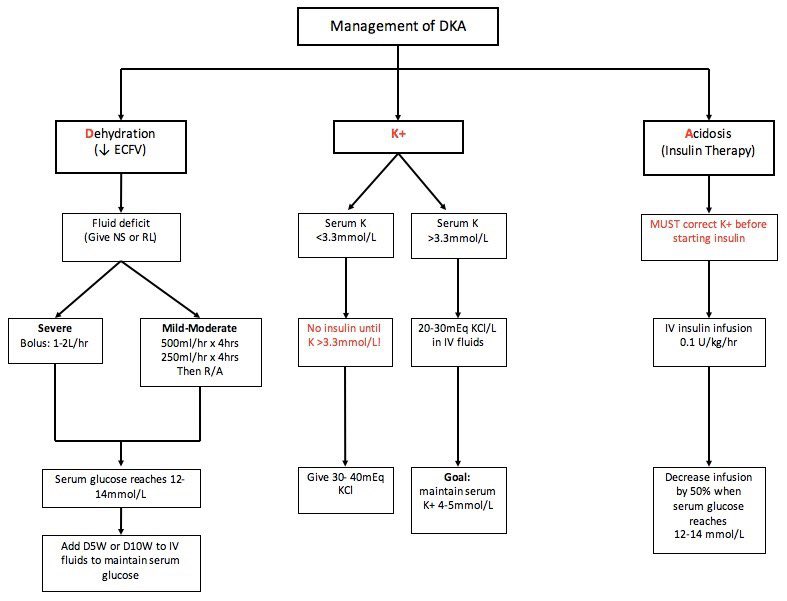
And finally, This picture simplifies how can we manage DKA and remember it’s an emergency condition and need rapid medical intervention 🚨.
جاري تحميل الاقتراحات...