

As a practicing hospital pharmacist (not specialized in critical care pharmacy), you have been asked to cover the clinical duties in the ICUs. What are the barriers that might challenge you? Please write down the poll if you have others reasons.
Thanks all for voting. I do agree that all of these challenges might affect you. I’ll be sharing some tips that might help non ICU pharmacists in their first time of covering ICUs. When things look like this, where should you start?
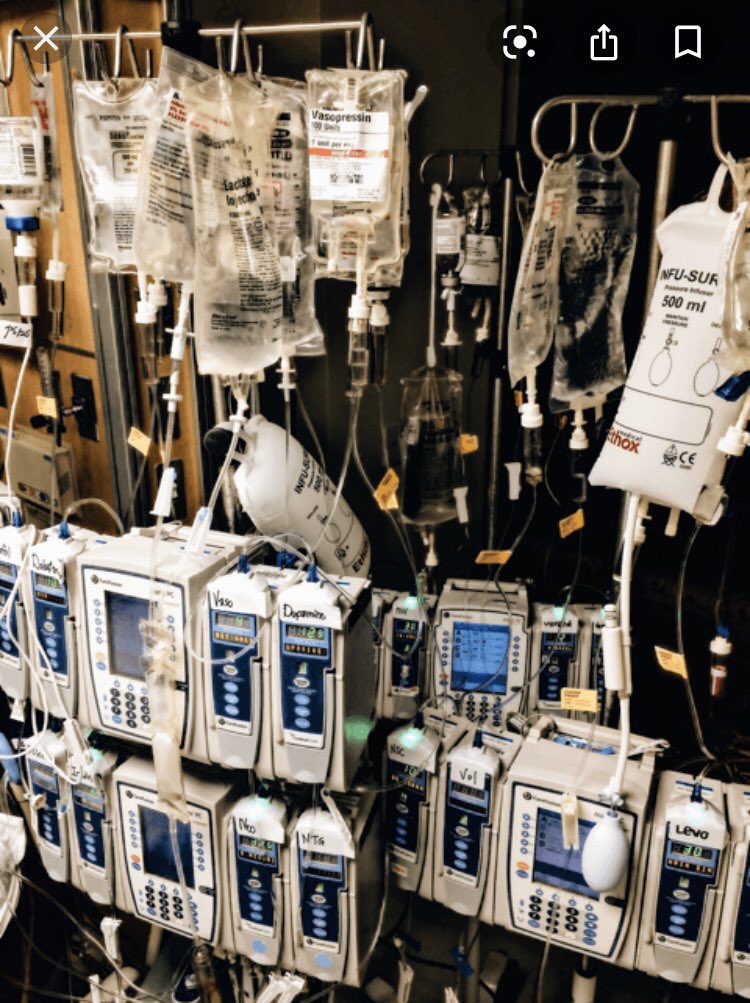
As shown in the voting the lack of experience and the complexity of the cases were the highest. To a lesser extent fear of unknown and high demands in the area. In this thread I’ll be sharing tips that have helped me in my first time in ICUs as a non ICU pharmacist back in 2008.
Besides tons of advices as a specialized critical care pharmacist 12 years later.
I’ll not start by resources for reading and guidelines, also I’ll not talk about medications...etc
I’ll not start by resources for reading and guidelines, also I’ll not talk about medications...etc
1/Know the ICU protocols, each hospital and critical care units have several protocols. These protocols are either guidelines driven, or hospital-based on best practice. Understanding your units’ protocols will save you a lot of time and effort when assessing therapeutic plans.
2/don't start your patients work up by reviewing medications. Use the ICU checklist, there are tons of readily available ICU checklists that can be utilized by any ICU staff. One commonly uses is the FASTHUGBID.
Besides that, I have created 14 questions list based on FASTHUGHBID that any pharmacist should answer when working up ICUs patients. One of the advice is to review the patients head to toes and link each systematic problem to its related therapeutic plan.
Now you are familiar with the ICU protocols & you have created ICU checklist (there is no right or wrong use any list that ensures covering all aspects of the therapeutic plan). Always tell my trainee, if you don’t know the protocols and not using ICU checklist you will be lost!
3/Play in your playground, once you start reviewing the patient’s profile, we tend to be lost with a huge amount of information especially for long-standing ICU patients. Don’t overwhelm yourself with information that other providers are taking care of.
Remember, ICU team is a multidisciplinary team and each member has it own scope of practice. So be the PHARMACIST and focus on the information that helps you to assess the patients' therapeutic plans.
4/I can’t stress enough about prioritization. In ICUs each patient deserves to be seen by ICU pharmacists. Remember to prioritize. See overnight admissions before other patients, see sicker patients before stable patients, see patients on high-risk medications first…etc.
5/Have more questions than answers. Remember, you are in a rapid pacing environment, things change very fast, patients becoming unstable suddenly, therapy needs to be changed frequently, minor errors can be a major error in ICU patients.
” don’t rush yourself to answer the questions but question everything”
6/Train yourself that things can’t wait in the ICUs. If you want the adjust medications, make recommendations…etc. do it when it is time. Practice critical thinking and divide your recommendations to part need to be addressed now, some can be addressed during the round..
others could be done after round. Remember to close the loop and to communicate your recommendation clearly to the person taking care of that patient (multiple levels of care in ICU requires multiple providers involved in one patient, things get lost in the communication cycle)
7/One size doesn’t fit all. A Septic patient in ICU bed 1 is not the same as a Septic patient in ICU bed 2, there are tons of points making their management completely different!
8/Don’t listen to your internal beliefs! Not all ICU patients are comatose, not everyone in ICU are intubated, CrCl is not the best for dose adjustments, sedatives, pressors, analgesics drips are MEDICATIONS.needs to be addressed frequently and we should work on weaning them ASAP
9/For first time in ICU, emotions can get you so hard, connections with your ICU patients, feeling that you are coming part of their story is very common. One piece of advice to overcome this emotions rollercoaster is..
to remind yourself by being a pharmacist in the ICU you going to have a huge part in saving patients lives..“one minor intervention in the therapy could have a huge impact on the ICU patient's life” that should relief you a lot:)
10/Yes! fear of unknown is challenging, especially walking in the unit in am not knowing what to expect today ,next hours. next minutes…etc. I recall several days in my residency walking at 5:30 am in 20 beds MICU as the sole ICU pharmacist not knowing what to expect…
I hear you it is scary but if you know your purpose, utilize the above-mentioned tips & start by belief that “you don’t know it all and you will never do" it is ok to ask, It is ok to look things up, it is ok to seek help. The first step to overcome this fear is to be there :)
Last, I’ll leave you with one great resource that helps thousands of hospital pharmacists in their ICU rotation @PharmacyJoe. Please write down if you have any tips that you recommend to survive ICU pharmacy duties.
Loading suggestions...