

All right #medtwitter, you asked, & I'm going to try to deliver. Here's a #tweetorial/#medthread on...
#ALOPECIA!
***I'm not a hair expert, but hopefully this will just provide a framework to think about this problem***
#dermtwitter #MedEd #FOAMEd #dermatology pc:@dermnetnz
1/
#ALOPECIA!
***I'm not a hair expert, but hopefully this will just provide a framework to think about this problem***
#dermtwitter #MedEd #FOAMEd #dermatology pc:@dermnetnz
1/
Let's say a patient complains of his/her hair falling out. In the spirit of examining first as #dermatologists tend to do, let's start with the exam. This is the easiest way to differentiate between the two types of alopecia: scarring and non-scarring. What do you look for?
2/
2/
While all the above options can help with the ultimate diagnosis, it's the preservation of follicular ostia (or loss of said finding) that helps point you in the right direction. Whether it's scarring or non-scarring can really help narrow your differential.
3/
3/

But now let's assume you're not a #dermatologist! Perhaps you would take the "No Idea!" arrow from the prior figure. If that's the case, the paper that @AdeAdamson shared on a prior tweet can be very helpful in using the history to differentiate types.
4/
4/
I think doing both of these makes the most sense. Whichever method helps you narrow your differential down more really helps you narrow your questioning. Part of the work up though includes a thorough H/P, which includes a good exam +/- a hair pull test and a good history.
5/
5/
What exactly is a hair pull test? I've heard it described in different ways, but I was taught to grab ~50 hairs between two fingers, pull gently in 3 areas of the scalp. If >10 hairs come out, it's positive. If so, consider effluvium, areata, scarring processes, inflammation.
6/
6/
But, you need to know when the patient last showered. Our alopecia patients often avoid showering because they see a lot of hair come out. This doesn't work though, and more hair just comes out the next time. That said, if they haven't showered, you can get a false positive.
7/
7/

It's also important to remember other medical causes of hair loss, including thyroid, rheumatologic, infectious processes (eg: syphilis!), nutritional deficiencies, anemia, etc! This is obviously tailored based on history and physical, but important not to forget about them!
8/
8/
Some caveats before we launch into some diagnoses:
1 - I'm going to cover some of the more common diagnoses we see. This is not a thorough a review!
2 - Unfortunately, the photos from dermnetnz are mainly of fair-skinned pts. Some alopecias affect different ethnic groups more.
9/
1 - I'm going to cover some of the more common diagnoses we see. This is not a thorough a review!
2 - Unfortunately, the photos from dermnetnz are mainly of fair-skinned pts. Some alopecias affect different ethnic groups more.
9/
Ok, let's start with NONSCARRING:
The most common is male/female pattern baldness. Typical findings: usually neg hair pull, hair thinning, no erythema, & an overall "classic" pattern. Male pattern affects vertex & temporal. Female anterior scalp (with a "widened" part).
10/
The most common is male/female pattern baldness. Typical findings: usually neg hair pull, hair thinning, no erythema, & an overall "classic" pattern. Male pattern affects vertex & temporal. Female anterior scalp (with a "widened" part).
10/


Treatment is usually minoxidil (with paradoxical hair shedding at start of treatment) and possibly finasteride. Some more experimental treatments include PRP, spironolactone for women (even topical versions), and light treatments. Hair transplant is also possible.
11/
11/

Alopecia areata is also seen with relative frequency. Patients often have a discrete patch of alopecia without any induration or atrophy. This can be associated with thyroid disease, but once that's ruled out, treatment is usually with intralesional steroids to start.
12/
12/

Areata can be much more extensive, and can be totalis (all the hair is lost) or universalis (all body hair is lost!). Nails can pit too! More experimental treatments that have been effective include systemic steroids, JAK-inhibitors, dupilumab (in the setting of eczema), etc!
13/
13/


Remember that severe inflammation in the scalp can also lead to hair loss. Usually I think of psoriasis or seb derm (pic 1,2). If it also comes w/terrible pruritus, I think more about dermatomyositis (3). Also, tinea capitis (4) can be a reason for localized hair loss.
14/
14/


EXAM FINDINGS in SCARRING alopecias can help. Aside from lost ostia, if it's been long enough, you can have multiple hairs coming through one follicle (because they need a place to go). It's described like "doll's hair." Erythema also implies there's inflammation to combat!
15/
15/
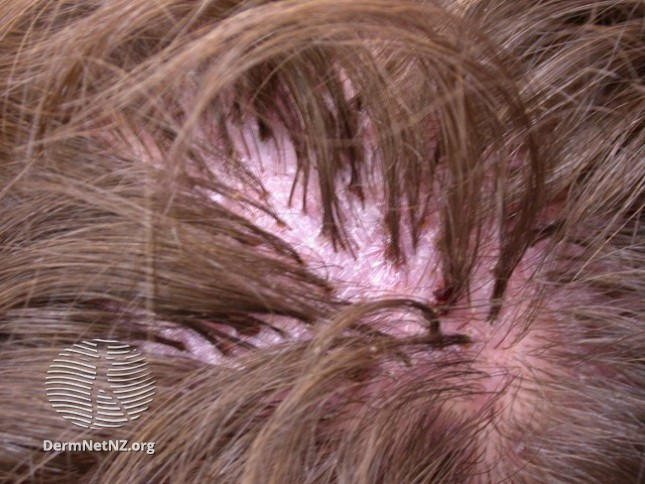
We treat scarring alopecias rather aggressively because we want to try to preserve hair growth potential as much as possible! Discoid lupus can be atrophic changes, have a whiter rim, especially if old, & usually affects conchal bowls! I usually start with hydroxychloroquine.
16/
16/

Lichen planopilaris classically has perifollicular erythema, and treatment aside from hydroxychloroquine, includes more aggressive immunosupressants, like mycophenolate in some cases. Frontal fibrosing alopecia is the variant that affects the frontal hairline.
17/
17/

One last one I'll cover - traction. This one is important because if caught early, the hair can grow back. If it's been too long, it can be permanent. Patients who pull their hair back can cause this type of alopecia. Usually it's in the front 2/2 a tight ponytail/braids.
18/
18/

Other exam maneuvers include trichoscopy (looking at the root of the hair under a microscope), tracking hair growth with standard measurements and photos, and of course, a biopsy can help depending on pattern of inflammation and clinical correlation.
19/
19/

Recap:
- alopecias can be divided as scarring non scarring, or by historical factors.
- a good exam, good history, and +/- biopsy are needed to decide on not only type of treatment, but urgency of treatment.
- Send patients to a #boardcertifieddermatologist for more help!
20/20
- alopecias can be divided as scarring non scarring, or by historical factors.
- a good exam, good history, and +/- biopsy are needed to decide on not only type of treatment, but urgency of treatment.
- Send patients to a #boardcertifieddermatologist for more help!
20/20
Oops! Forgot to answer @AnnYoungMD's question about #pediatrics ddx:
Basically, some of these move to the top in young patients, like tinea capitis, and alopecia areata, trichotillomania. Also, if they've been pulling hair back for awhile, traction is up there too!
21/21
Basically, some of these move to the top in young patients, like tinea capitis, and alopecia areata, trichotillomania. Also, if they've been pulling hair back for awhile, traction is up there too!
21/21
Loading suggestions...